The Psychology of Free
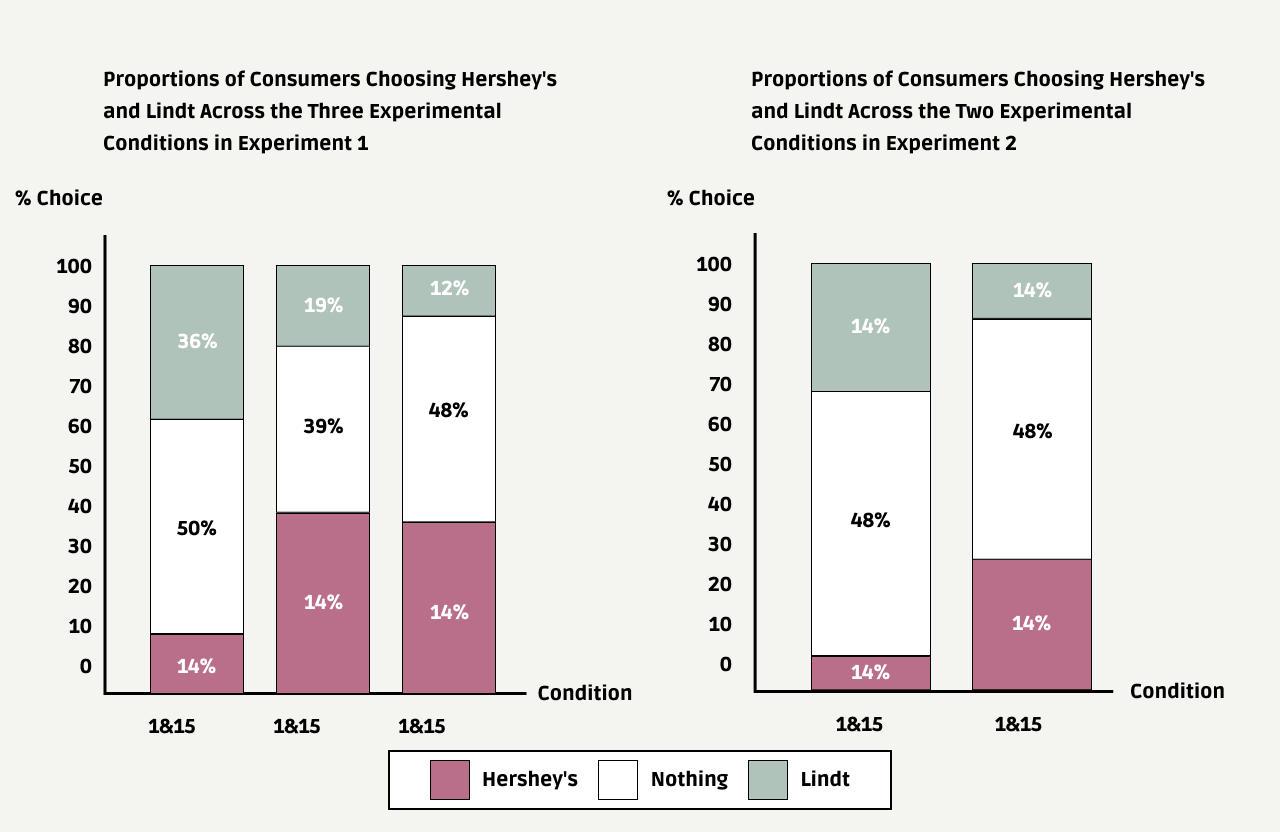
In 2007, a controlled experiment presented participants with a choice between a Hershey's Kiss at one cent and a Lindt truffle at fourteen cents. Twenty-seven percent chose the Kiss. When the Kiss was reduced to zero and the truffle to thirteen cents, sixty-nine percent chose the inferior chocolate. The shift from one cent to zero—a trivial monetary difference—produced a 156% increase in preference for the lower-quality product. This is the zero-price effect, and it is reshaping SaaS economics.
In 2007, a controlled experiment presented participants with a choice between two chocolates. One was a Hershey's Kiss, a mass-market confection of moderate quality. The other was a Lindt truffle, a premium product with demonstrably superior ingredients. When the Hershey's Kiss was priced at one cent and the Lindt truffle at fourteen cents, 27% of participants selected the Hershey's Kiss. When the price of the Hershey's Kiss was reduced to zero and the Lindt truffle to thirteen cents, 69% of participants chose the inferior chocolate.
The shift from one cent to zero—a trivial monetary difference—produced a 156% increase in preference for the lower-quality product. This outcome violates standard economic models of consumer choice, in which a one-cent reduction should produce only a marginal shift in demand. The phenomenon, subsequently termed the "zero-price effect," demonstrates that zero is not merely another price point. It functions as a distinct psychological category that alters valuation mechanisms, often causing consumers to select options that provide objectively less value.
The phenomenon extends beyond confectionery. Field research in healthcare markets has documented that an infinitesimal price increase from zero to a nominal copayment reduces the probability of pediatric physician visits by 4.8%—an effect roughly half the magnitude of a 10% coinsurance requirement [3]. Conversely, when incidental costs are high, zero pricing can trigger what researchers term a "boomerang effect," causing demand to fall below that of a low, nonzero price [2]. Zero simultaneously attracts and repels, depending on context.
The Documentation
Original Experimental Evidence
Shampanier, Mazar, and Ariely (2007) conducted the foundational research on zero pricing at the Massachusetts Institute of Technology and Duke University, published in Marketing Science [1]. The study utilized a between-subjects experimental design in which participants made binary choices between products at various price points. The critical manipulation involved reducing the lower-priced item from a low positive price (one cent) to zero while maintaining a constant price differential with the higher-quality alternative.
The standard economic model predicts that demand should shift linearly with price changes. The experimental results violated this prediction. When both prices were reduced by identical amounts, the shift from a positive price to zero produced a disproportionate demand increase for the free item. The authors proposed that zero evokes a positive affective response that operates independently of rational cost-benefit calculation. This affective charge effectively inflates the perceived value of the free product beyond its objective utility.
The Dual-Process Extension
In 2022, research published in the Journal of the Academy of Marketing Science advanced a dual-process model explaining the boundary conditions of the zero-price effect [2]. Across five studies—including field data from 3,511 tutoring classes offered by a major Chinese education company—the research demonstrated that zero pricing produces two competing psychological reactions: a positive affective pathway (the "boosting effect") and a cognitive scrutiny pathway (the "boomerang effect").
When incidental costs—defined as nonmonetary expenditures such as time, effort, or risk—are low, the affective pathway dominates. A zero price increases demand relative to a low, nonzero price. However, when incidental costs are high, zero pricing triggers heightened scrutiny of those costs. In field data, offline classes with high commute time costs showed an inverted-U relationship between price and demand, with demand peaking at a low, nonzero price and declining at zero.
The mechanism was confirmed through moderated mediation analysis. Under high incidental costs, participants offered zero-priced items generated significantly more concerns about time and effort requirements than those offered low, nonzero prices. The zero price directed cognitive resources away from affordability assessment—unnecessary when the product is free—and toward scrutiny of hidden costs.
Healthcare Field Evidence
A separate field study utilizing administrative data from child healthcare plans examined whether zero functions as a discontinuous price point in actual purchasing behavior. The research, presented at the American Economic Association, analyzed utilization patterns across multiple cost-sharing tiers: zero, two dollars per visit, and 30% coinsurance [3].
The analysis documented that demand at zero price deviated significantly from the demand curve projected by near-zero price responses. An infinitesimal increase from zero to a nominal fee reduced physician visit probability by 4.8%. The effect was concentrated among healthier children who frequently visited physicians, suggesting that zero pricing encourages low-value utilization. For high-value preventive services, however, zero pricing appropriately increased demand without corresponding waste.
The Manifestation
A mid-sized software-as-a-service company (anonymized) introduced a free tier in 2021 to accelerate user acquisition. The product was a project management tool with a robust paid tier at $29 per user monthly. The free tier offered limited functionality: three projects, one user, and basic task management.
Within sixty days, sign-ups increased 340%. Conversion to paid tiers, however, fell from 8.2% to 1.4%. More critically, support ticket volume increased 280%, driven primarily by free-tier users requesting features explicitly excluded from the free offering. The cost of servicing free users—measured in support hours, server load, and engineering time diverted to non-revenue-generating accounts—consumed 34% of operational capacity while producing less than 2% of eventual revenue.
The company had assumed that the free tier would function as a rational acquisition funnel. Prospects would evaluate the limited product, recognize its utility, and upgrade for expanded functionality. What occurred instead was a behavioral distortion. Users attracted by "free" evaluated the product not as a trial of premium capabilities but as a complete solution. When confronted with paywalls for essential features, they did not upgrade; they churned, often after consuming significant support resources.
The diagnostic error was the assumption that zero was merely a low price. The company had priced its free tier at zero, triggering the affective response documented by Shampanier et al. (2007) [1], but failed to account for the high incidental costs of product migration—learning a new system, transferring data, rebuilding workflows—that produced the boomerang effect identified in subsequent research [2]. Users invested time in the free product, encountered friction when attempting to scale, and attributed the friction to product deficiency rather than tier limitation.
The Identification
Indicators
- Preference Reversal at Zero: If a product or tier experiences disproportionate adoption when priced at zero compared to its performance at $1, $5, or nominal fees, the zero-price effect is likely operative. A linear demand curve would predict modest increases; a 3x or greater spike suggests affective distortion.
- Quality Perception Decoupling: When zero-tier users rate product satisfaction lower than paid users despite receiving equivalent core functionality, they are likely evaluating the product through the lens of anticipated completeness rather than objective utility. The free price signals that something is missing, even when it is not.
- Support Intensity Inversion: If free-tier users generate support tickets at rates equal to or greater than paid users, the incidental costs of the "free" offering are higher than the business model assumes. The zero price attracted users who require extensive assistance but have no investment in self-resolution.
- Conversion Asymmetry: If conversion from a $1 trial to paid is significantly higher than conversion from a free tier to paid, the nominal fee is functioning as a quality filter. The one-dollar charge triggers cost-benefit calculation; the zero price triggers affective response without corresponding commitment.
Shadow Cost Calculation
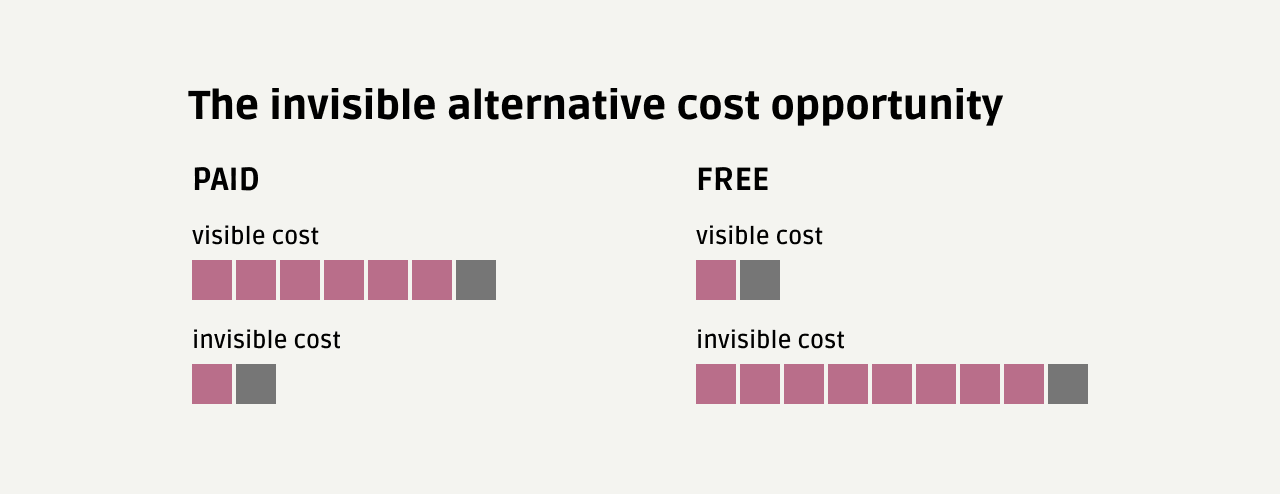
The true cost of a free tier is not the forgone revenue from users who would have paid. It is the operational burden plus the opportunity cost of misallocated attention:
Zero-Tier True Cost = (Support Hours × Hourly Rate) +
(Server / Infrastructure Cost) +
(Engineering Diversion Cost) +
(Brand Dilution from Low-Value Association)
For the software company in Section 3, the calculation revealed that each free user cost $18.40 in operational support while generating $0.00 in direct revenue and converting at 1.4%. A $9 trial converting at 12% would have produced superior unit economics despite lower top-of-funnel volume.
Differential Diagnosis
The zero-price effect must be distinguished from:
- Genuine product-channel fit: Some products (viral social tools, network-effect platforms) require mass free adoption to function. The zero-price effect is a distortion; network effects are a structural requirement.
- Freemium as market education: In nascent categories where prospects cannot evaluate value without hands-on experience, free tiers serve educational purposes. The zero-price effect operates when prospects can evaluate value through other means (demos, case studies, testimonials) but choose free due to affective charge.
- Price sensitivity: Economically constrained buyers may genuinely require free options. The zero-price effect operates on buyers who could pay nominal amounts but choose zero due to psychological discontinuity.
Severity Markers
- Acute: Free users comprise less than 30% of the user base; support load is manageable; conversion, though low, funds acquisition. The effect is present but contained.
- Chronic: Free users exceed 60% of the base; support costs approach or exceed paid-tier margins; product roadmap is influenced by free-user feature requests. The business model is being reshaped by the distortion.
- Terminal: Free-tier operational costs exceed lifetime value of converted users; paid-tier pricing is being reduced to compete with internal free options; the product is perceived as a "free tool" in market positioning. The brand has been captured by the zero anchor.
The Resolution
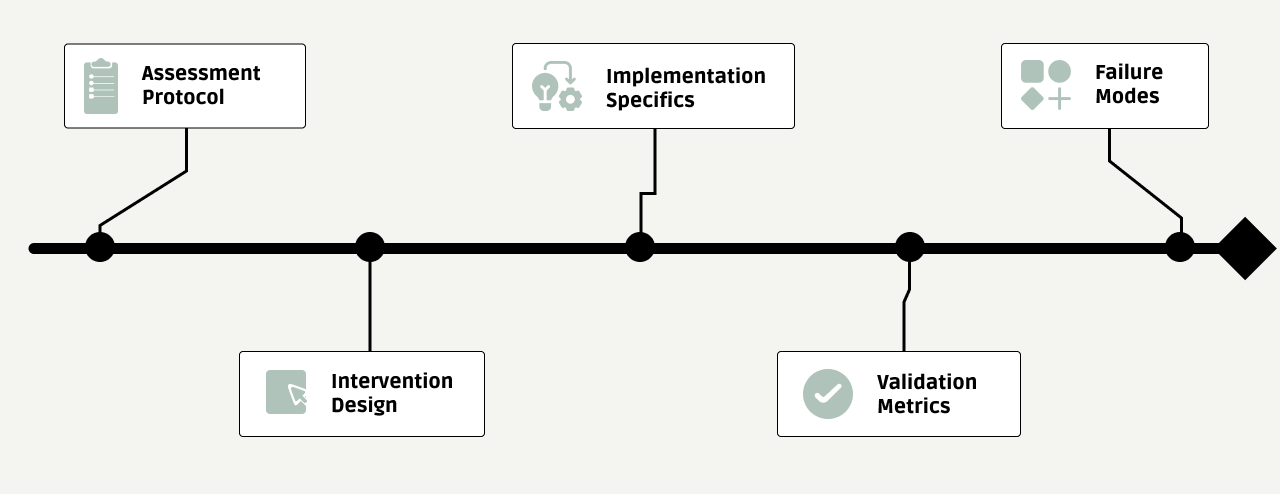
Part A: Assessment Protocol (Week 1)
Before modifying pricing architecture, establish baseline measurements:
1. Tier Composition Analysis
Calculate the percentage of active users by tier (free, entry paid, premium) and the operational cost per tier. Include support hours, server costs, and estimated engineering time allocated to tier-specific requests. Track this for fourteen days.
2. Conversion Funnel Mapping
Document conversion rates at each stage: visit → free sign-up → free activation (defined as completing core action) → paid conversion. Compare with industry benchmarks. If free-to-paid conversion is below 5%, the zero-price effect is likely suppressing commitment.
3. Support Ticket Categorization
Classify all support tickets by tier and request type. If free-tier tickets are primarily "how do I do X" where X is a paid feature, users are treating the free tier as incomplete rather than limited. If free-tier tickets are primarily "why doesn't this work," users are treating the free tier as defective.
Part B: Intervention Design (Weeks 2-8)
Phase 1: The Nominal Filter (Weeks 2-3)
Replace the zero-price tier with a nominal fee tier. The amount is less important than its existence; research confirms that even one cent triggers cost-benefit calculation rather than affective response [1]. However, in practice, a nominal fee of $1 to $5 is administratively cleaner and signals value without creating meaningful barriers.
Implementation Steps:
- Announce the change sixty days in advance to existing free users, offering grandfathered access or a migration discount.
- Introduce the new entry tier at a nominal price ($1 to $9) with explicit, generous functionality. The goal is not revenue extraction but psychological reframing.
- Remove the word "free" from all primary marketing materials. If a free option remains for enterprise qualification or nonprofit status, segregate it from the standard pricing page and require application.
Phase 2: Value Articulation (Weeks 4-5)
The zero-price effect distorts because users cannot calculate value when no price exists. Provide explicit value anchors.
Implementation Steps:
- On the pricing page, display the full hypothetical cost of the entry tier if purchased as individual components or services. For example: "Project management setup: $500. Training: $300. Support: $200/month. Included in your $9 plan."
- Include a "cost of inaction" calculator on the website. Allow prospects to input their current manual process (hours spent, errors made, delays incurred) and receive a calculated monthly cost of their status quo. The nominal fee for the product is then presented as a reduction, not an expense.
- Ensure that every pricing tier includes at least one feature that produces a measurable time or cost savings within the first seven days of use. The user must be able to calculate ROI without assistance.
Phase 3: The Incidental Cost Audit (Weeks 6-7)
If a free tier must be retained for strategic reasons, reduce the incidental costs that trigger the boomerang effect [2].
Implementation Steps:
- Map the user journey from sign-up to first value moment. Identify every nonmonetary cost: required form fields, verification steps, data entry, tutorial completion, waiting periods.
- Eliminate or defer every incidental cost that does not serve a legal or security purpose. If a tutorial is required, make it actionable (producing a real output) rather than informational.
- For retained free tiers, implement a "success checkpoint" at the twenty-four-hour mark. If the user has not completed the core activation action, send a single manual message offering direct assistance. Do not automate this; the personal touch reduces the perceived effort cost of continued use.
Phase 4: Conversion Architecture (Week 8)
Restructure the transition from entry tier to premium so that it feels like continuation rather than escalation.
Implementation Steps:
- Instead of gating premium features with paywalls, implement "usage ceilings." The entry tier allows three projects; the premium tier allows unlimited projects. The feature is identical; the capacity differs. This avoids the perception that the entry product is incomplete.
- When users approach a ceiling, provide a single-click upgrade path with a prorated credit for the current period. The transaction should require fewer than three clicks and no re-entry of payment information.
- At the point of upgrade, display a "progress preservation" message: "All your work transfers automatically. Nothing changes except the limit." This addresses the incidental cost of migration that triggers the boomerang effect.
Part C: Implementation Specifics
Decision Matrix for Retaining Free
| Condition | Action |
|---|---|
| If free users convert to paid at >8% and support cost per free user is <$5 | Retain free tier as acquisition channel |
| If free users convert at 3-8% and support cost is $5-$15 | Introduce nominal fee ($1-$5) and measure conversion change for 30 days |
| If free users convert at <3% and support cost exceeds $15 | Eliminate free tier; replace with time-limited trial or demo |
| If free tier exists primarily for enterprise "land and expand" | Segregate free tier from public pricing; require sales qualification |
Templates for Transition Communication
Announcement to Existing Free Users (Email):
"Effective [Date], the Starter plan will be $5 per month. This change allows us to provide the support and infrastructure that early-stage users require. As an existing user, your current plan is grandfathered for [X] months. If you choose to upgrade during this period, your rate will be [Discounted Rate]."
Pricing Page Copy (No "Free" Mention):
"Starter: $5/month. Includes core project management for individuals and small teams. Setup assistance included. Upgrade or cancel at any time."
Part D: Validation Metrics
Track weekly during the intervention:
- Sign-up Volume: Expect a 40-60% reduction in top-of-funnel sign-ups. This is the intended filtering effect, not a failure.
- Activation Rate: The percentage of new users who complete the core action within seven days. Should increase from baseline due to higher commitment.
- Conversion Rate: Free or nominal-tier to paid. Target: >10% within sixty days.
- Support Ticket Ratio: Tickets per user by tier. Should decline in the entry tier as low-commitment users self-select out.
- Lifetime Value: Average revenue per user acquired through the entry tier. Should exceed acquisition cost within ninety days.
Part E: Failure Modes
- The Panic Reversal: When sign-ups drop, management reinstates the free tier before the sixty-day evaluation period concludes. The volume recovers but the economics remain broken. The intervention requires sixty days minimum.
- The Feature Bloat: To justify the nominal fee, the business adds features to the entry tier, increasing operational cost and replicating the free-tier burden at a lower price. The nominal fee must be justified through positioning and value articulation, not feature accumulation.
- The Parallel Universe: The business maintains both a public free tier and a hidden paid tier, hoping the paid tier will "naturally" attract serious users. Users universally select the free option; the paid tier atrophies. One primary entry point must exist.
- The False Scarcity: The business implements a nominal fee but immediately discounts it to zero with coupon codes, replicating the original distortion while adding administrative friction. The price must be real and consistently applied.
- The Enterprise Delusion: The business retains free tiers because "enterprise clients start as free users." In practice, enterprise buyers rarely self-serve from free tiers; they engage through sales processes. The free tier serves individual users, not enterprise procurement.
Resources & References
- 1Zero as a special price: The true value of free productspaperMarketing Science
- 2The boomerang effect of zero pricing: When and why a zero price decreases consumer demandpaperJournal of the Academy of Marketing Science
- 3Is zero a special price? Evidence from child healthcarepaperAmerican Economic Association Papers and Proceedings
All sources verified and archived